
About Me
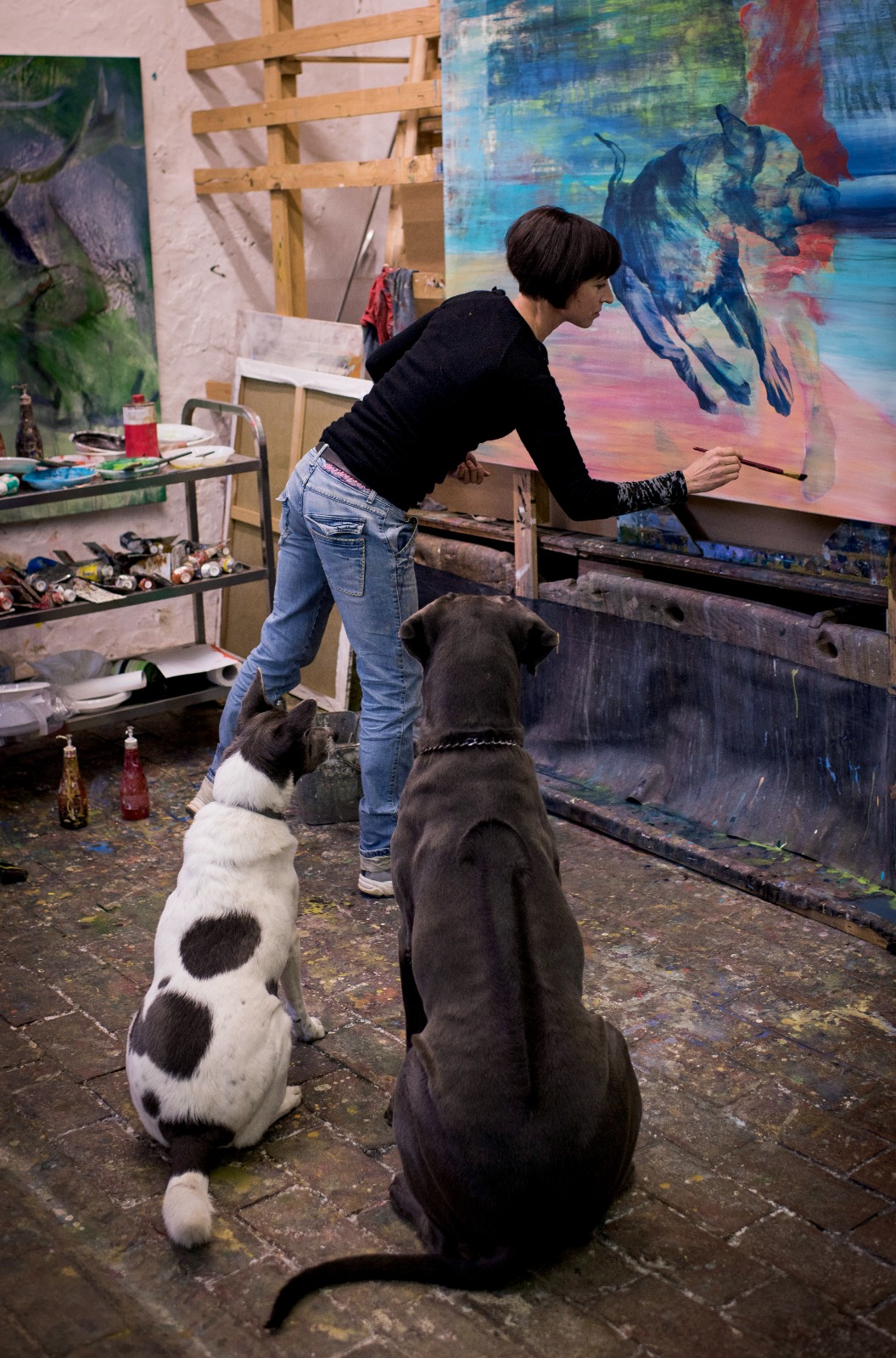
Margit Platny’s oeuvre follows a single, strong and rigorous concept which could be described as „hybridization“. It is inspired by science but widely used metaphorically in many other fields, and it forms the baseline of Margit’s entire creative experience.
The same applies to her cultural and educational background which is based on a few fundamental milestones:
her time at the Academy of Fine Arts in Vienna, her investigation of artistic movements such as figurative abstraction or, rather, abstract expressionism and incursions into the works of artists like Berlinde de Bruyckere, Helen Frankenthaler, Francis Bacon and Louise Bourgeois, which are all characterized by emotional abstraction and an intuition-driven process that mirrors deep inner states, and, finally, her choice to live in the countryside, in an environment entirely surrounded by raw, untamed nature.
Platny’s technique is also guided by „hybridization“. She developed a process where drawing and painting overlap and fuse through unprecedented experiments of layering or subtraction, executed either “gently” or “aggressively,” over a long period of time or in an instant.
A sort of spiritual energy channels the deepest and sometimes contradictory moods and keeps the fate of the artwork alive until the very last moment. As in the finest examples in the history of art, her paintings sometimes deviate from the initial idea. They often take an unexpected turn, sometimes even in terms of the technique(s) she applies – to produce unforeseen images that remain, however, coherent within the original intent. Glazes and/or abrasions concur on the way to the final image which, at a certain stage of the process, reveals and unveils itself.
But what are these images, where are they going, and where are they leading us? Platny’s works speak of and depict many emotional, visionary and poetic experiences. Her paintings focus on the symbiotic, indissoluble and biological relationship between humans and nature. The results are striking images, ritual exorcisms, and hybrid mythologies, where aesthetics is driven by the urgency to create and denounce. She drags us back into the mystery of creation and the melancholy of regret. Her works make their viewers step back in time to the threshold of the Anthropocene. They invite – or even challenge – us to observe possible alternative models of an honest and sincere relationship between humanity and nature.
Andrea Milani